Introduction
So you’ve decided to make it official. Good. But the business registration process can feel like a maze of forms, portals, and government offices that all seem to want different documents. It doesn’t have to be this confusing. In 2026, most of it can actually be done online, and this guide walks you through exactly what to expect, in the order you’ll actually need it.
Why Registration Matters More Than You Think
A lot of small business owners delay registration because “it’s just extra paperwork.” Fair point, but it costs you.
Without completing the business registration process, you can’t open a proper current account, apply for loans, or work with larger clients who need GST invoices — it directly limits how big your business can grow.
I’ve seen freelancers lose contracts simply because they couldn’t raise a GST bill. That’s a painful way to learn this lesson.
Step 1 — Choose Your Business Structure
This decision shapes everything after it.
- Sole Proprietorship — simplest, fastest, best for solo freelancers
- Partnership Firm — two or more people, shared liability
- LLP (Limited Liability Partnership) — protects personal assets
- Private Limited Company — best for startups planning to raise funding
Don’t overthink this at the small-scale stage. A sole proprietorship is enough for most local businesses; you can always upgrade later.
Match Structure to Your Goals
If you’re planning to raise investor money in the next year or two, go Private Limited from the start. Changing structure later means redoing several registrations.
Step 2 — Get Your PAN and Digital Signature Sorted
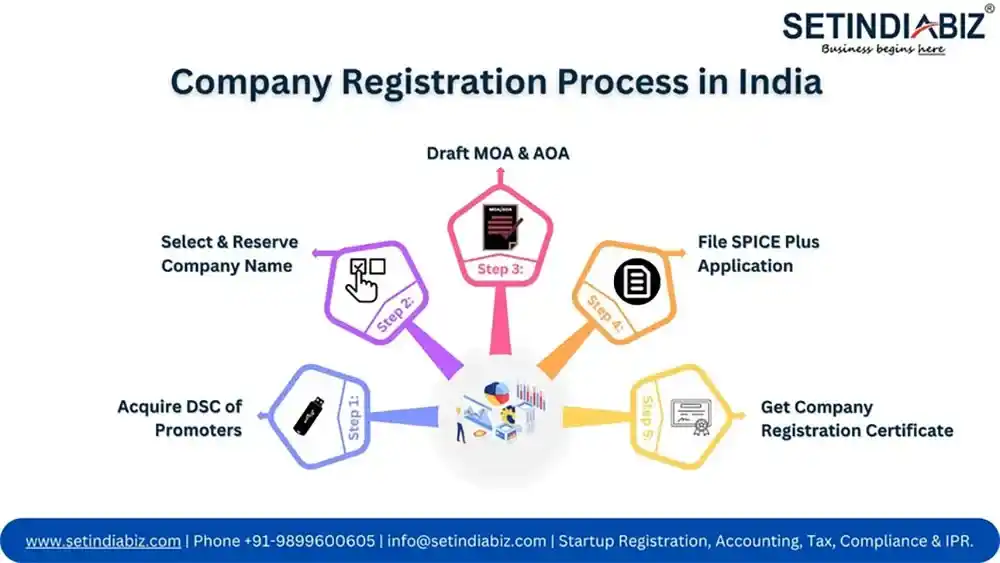
Your business PAN (or personal PAN for sole proprietorships) is the foundation document. For companies and LLPs, you’ll also need a Digital Signature Certificate (DSC) for the director or partner filing the registration.
This part usually takes 2-3 working days if documents are ready.
Step 3 — Register on the MCA Portal (For Companies/LLPs)
For Private Limited or LLP structures, registration happens through the Ministry of Corporate Affairs (MCA) portal using the SPICe+ form.
- Reserve your company name
- Fill in director and shareholder details
- Upload address proof and identity documents
- Submit the Memorandum and Articles of Association
- Wait for the Certificate of Incorporation
This typically takes 7-15 days depending on document accuracy.
Step 4 — Apply for GST Registration
Once your entity exists, GST registration is next if your turnover crosses ₹20 lakh (₹10 lakh for some states) or if you want to raise GST invoices regardless of turnover.
[link to related guide about GST basics for small businesses here]
Step 5 — Open a Current Bank Account
Banks will ask for your Certificate of Incorporation (or registration proof), PAN, and address proof. A current account, not a savings account, is what you need for business transactions.
Step 6 — Apply for Additional Licenses If Needed
Depending on your industry, you might also need:
- Shop and Establishment Act license
- FSSAI license (food businesses)
- Trade license from your local municipal body
Not every business needs all of these — check what applies to your specific setup.
[link to related guide about startup mistakes here]
FAQ
How long does the business registration process take in India? For a sole proprietorship, it can take just a few days. For LLPs or Private Limited companies, expect 7-15 working days through the MCA portal.
Do I need a lawyer to register my business? Not necessarily for a sole proprietorship, but for LLPs and companies, a CA or company secretary usually saves you from filing errors.
What’s the cheapest business structure to register? Sole proprietorship — often just needs a PAN, bank account, and possibly a GST or Udyam registration.
Is Udyam registration the same as business registration? No. Udyam is an MSME registration for benefits like loans and subsidies; it doesn’t replace your primary entity registration.
Can I register my business from home without an office address? Yes, many small business owners register using their home address as the registered office.
Conclusion
The business registration process looks intimidating from the outside, but broken into steps, it’s genuinely manageable in 2026. Pick the right structure, get your documents ready, and move through MCA, GST, and banking one at a time. Don’t let paperwork be the reason your idea stays stuck — start the process this week instead of waiting for the “right time.”
Suggested image alt text: “business registration documents and laptop on desk India”; “MCA portal company registration process screenshot”